Showing posts with label John 1:1-18. Show all posts

Sunday, February 27, 2011

Who is the Word of God? Why Should You Read His Book?

[This was shared during worship with the people of Saint Matthew Lutheran Church during worship this morning.]

John 1:1-3, 14
2 Timothy 3:16-17*
As you know, on Ash Wednesday, March 9, we begin a yearlong emphasis at Saint Matthew: Read the Bible in a Year.

The response to the announcement that we were going to read the Bible together in a year’s time has been gratifying! Some of our overachievers have already started reading the Bible. Several people have gotten or are looking at new Bibles, in translations that are more accessible. And I hope that those who, because of the current conditions of their eyes, find reading difficult will be able get an audio edition of the Bible, either through a vendor or at the library. (If you'd like help finding an audio Bible to purchase, let me know, and I'll try to help you with your selection.)

With Read the Bible in a Year coming in so short a time, I’m departing from my usual practice of preaching on the appointed lessons and instead today, focusing on two important passages of Scripture. I hope that they’ll help motivate and inspire you to join in reading the Bible this year. My aim is to do that by talking about two important questions:
  • First, what do we Lutheran Christians mean when we speak of “the Word of God”? 
  • And second, why should we bother reading the Bible?
So, let’s get to it. Please pull out a pew Bible and turn to page 611. There, you’ll find what’s known as the Prologue to John’s Gospel, John 1:1-18. We’ll consider just a few passages of the Prologue, verses 1 to 3 and verse 14. Read along with me silently, please.
“In the beginning was the Word, and the Word was with God, and the Word was God. He was in the beginning with God. All things were made through Him, and without Him nothing was made that was made.” [Now, slide down to verse 14.] “And the Word became flesh and dwelt among us, and we beheld His glory, the glory as of the only begotten of the Father, full of grace and truth.”
Long before the universe was created, there was the Word of God. This Word of God is not an “it.” Unlike an impersonal force, the Word of God can be known in the same way you know your family or your friends or your neighbors.

That’s why John says of the Word of God, “He was in the beginning with God” and “All things were made through Him, and without Him nothing was made” and “We have beheld His glory.”

I’m not emphasizing the maleness of those pronouns. What I am emphasizing is that the Word of God is a Being with passions and preferences and a personality.

It’s this Personality that the Old Testament book of Genesis tells us spoke to chaos and brought the universe into being: “’Let there be light’ and there was light.” It was the Word of God that made the light and you and me and everything else.

The New Testament book of Colossians says of the One John refers to as the Word of God: “In Him all things in heaven and on earth were created, things visible and invisible…all things have been created through Him and for Him.” And it says that in Him “all the fullness of God was pleased to dwell.” 

This Word of God, the One Who created the universe, took on flesh and, as John’s Prologue says, “dwelt, lived” among us.

The Bible confesses that Jesus is the Word of God.

God, it turns out, is the Great Communicator. He used His Word to communicate all that was needed to bring the universe into being.

And from the very beginning, He has communicated with His personal favorites, the apples of His eye, the pinnacles of creation, the only beings made in His image: the human race.

We human beings have often turned a deaf ear to the Word of God, of course. But God has never tired of communicating with us.

The Word of God ultimately came to us when He took on flesh, became one of us, bore our sin on the cross, and rose from the dead so His Word of forgiveness and new life could come to all who repent and believe in Jesus.

When we Lutheran Christians speak of the Word of God, we mean first and foremost, Jesus, the Second Person of the Trinity, Who sits on the right side—the power side—of God the Father. The Word of God is, above all, God the Son.

Some people claim to see a different God in the Old Testament than they see in Jesus in the New Testament. Lutherans never have seen such a difference.

And for good reason. When Jesus walked on this earth, He said that He and the Father were one. He quoted Old Testament Scripture and He said that He came not to abolish God’s Old Testament law, but to fulfill it. Everything He did and said was consistent with the Personality of God revealed in Old Testament times. The New Testament writers show how the law and the grace that Jesus communicated for all the world, Jews and Gentiles, was precisely the same law and grace God communicated to His people Israel in the Old Testament. The preacher of the New Testament book of Hebrews says of Jesus, the Word of God made flesh: “[He] is the same yesterday and today and forever.”

As Lutheran Christians, we believe that God speaks and has spoken to people with the same simple message through the centuries, one composed of two parts: Law and Promise.

The Law is the moral law as embodied in the Ten Commandments, which God has never rescinded, revoked, or amended.

The Promise is God’s promise of forgiveness and new life to all who will repent and believe in Him.

God has personalized that promise for the whole human race in Jesus. This is why Jesus has given us the great commission to make disciples of all the world.

It was in response to Jesus' great commission and to help people know the Word of God personally and so, have the chance to repent and believe in Jesus, that John wrote his Gospel. “Jesus did many other things in the presence of His disciples, which are not written in this book,” John writes near the end of his Gospel. “But these are written so that you may come to believe that Jesus is the Messiah, the Son of God, and that through believing you may have life in His Name.” 

Jesus is the Word of God and the Bible is the Word of God because, through the Holy Spirit, the Church has learned that the Bible perfectly reflects the message the Word of God has been communicating since Adam and Eve: Turn from sin, trust in Me, and live. The Bible is God speaking law and promise to us: the law to drive us to Him, the promise to reconcile us to Him for eternity.

So, if the Bible’s message can be summarized in a few minutes, why spend a year reading it?

It’s simple, really. The crush of life—what The Small Catechism calls, “the devil, the world, and our sinful selves”—can turn us into amnesiacs. We can forget all about Jesus, the Word of God, hurtling through our lives without a clue of how to live or what to do.

But in the Bible, God helps us to remember. God knows we need reminding.

That’s why Luther said that the born-again Christians of his day weren’t born-again enough. They thought of repentance and faith in Christ as a one-and-done deal. But Luther said, rightly I think, that if we don’t keep coming back to God each day to repent and be renewed in His forgiveness and love, we can drift away from God and from eternity with Him.

Reading the Bible regularly can help correct our courses through life.

That leads to a second passage of Scripture I’d like to ask you to look up in the New Testament, 2 Timothy 3:16-17. It’s on page 690 in the pew Bibles. It says:
All Scripture is given by inspiration of God [literally, it says all scripture is God-breathed; God invests His very life into the pages of this book!] and is profitable for doctrine, for reproof, for correction, for instruction in righteousness, that the [person] of God may be complete, thoroughly equipped for every good work. 
In the Bible, the Word of God—Jesus—gives us a treasury of tools by which God empowers us to live with faithfulness and to share God’s Word of law and promise that can bring eternity to all who believe in Jesus.

True story. Monique Govender grew up in a Hindu home in Durban, South Africa. Her family regularly worshiped numerous idols.

Then, in the space of twenty days, two of her siblings died. Monique’s mother became fearful and, maybe just to cover all her bases, began going to a church to secretly pray to the One the Christians said was the one and only God of the universe revealed in Jesus.

Monique’s father, an alcoholic and a physical abuser of his family, hated Christians. Maybe he’d met the kinds of counterfeit Christians who give Christianity a bad name. However it happened, he misunderstood Christian teachings.

Over the course of her childhood though, Monique encountered the Word of God at different times, each time having an impact on her. Once, at age four, she attended “a memorable church activity.” At seven, buying booze for her dad, she saw street performers do two skits: one about Jesus’ parable of the ten wise and foolish virgins and the other about Joseph, the son of Jacob from Old Testament times. Most influential of all was when she learned that her grandparents, lifelong Hindus, had come to faith in Jesus Christ and joined a local church.

At age 15, Monique herself came to faith in Christ. Then, her brother, after reading a Bible he had been given, came to believe in Jesus.

At first, Monique’s father was angry at his two children and refused to let his daughter worship at church. But, trusting in Jesus, the Word of God, Monique began to pray for her family, asking God to let her worship with other Christians and to help her father recover from his alcoholism and to stop being an abuser. “Eventually, she was allowed to go to church, and [amazingly] in time both her parents came to know Christ as well.”

Monique reflects on the goodness of God. “I am not sure of what God’s thoughts were for me, but in looking back, it seems like He’s been thinking about me. And it’s [amazing] to think that I was just an unknown girl…[But] God knew me, and even as a little child, I could feel that God was there with me.”

Jesus is the Word of God. The Bible is His book, written so that, no matter how “unknown” or alone or adrift or overwhelmed you may sometimes feel, God loves you.

God wants to be in relationship with you.

He wants to give you an abundant life here and in eternity.

He wants to guide you with His wisdom and love.

Read the Bible every day and let Jesus, the Word of God, speak His grace and truth into your life all the days of your life!

*The renderings of these two passages, as linked here, are from the New Revised Standard Version (NRSV) of the Bible. The Bibles in the pew racks of the Saint Matthew sanctuary are the New King James Version (NKJV). 

Thursday, December 30, 2010

What I Want: A Wasted Life

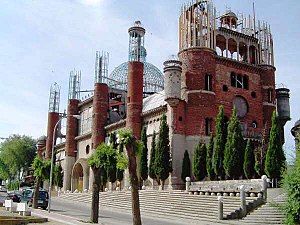
This BBC report tells about one-man's fifty-year plus project, undertaken after being expelled from a monastery for contracting tuberculosis.

The story appealed to me in several ways. Justo Gallego, the builder of a church building made of junk, who has no training in art or architecture, wanted to glorify Christ even though he could no longer be a monk.


One can argue whether this not-yet-completed and extravagantly unnecessary structure does glorify Christ. Some might dismiss the whole thing, perhaps rightly, as an eyesore. Or, as a danger to any who walk in it or near it. (There have never been any architectural plans or inspections of any kind.)

But before dismissing Gallego's church structure, consider some of the things this fifty-year effort may tell us about the life of faith and about Christ Himself.

Fifty-plus years ago, massive vaccination against TB had not begun in so-called developed countries, though there were treatment facilities that had some success. My mother, just a few years younger than Gallego, contracted the disease and spent some time at the Franklin County Tuberculosis Sanitorium in Columbus, when she was young.

Maybe the monastery lacked the capacity to care for Gallego as the sanitorium did for my mom. But his dismissal will do as a metaphor for what the institutional church sometimes does with those it doesn't know how to handle.

I myself have often experienced the institutional church as an organization peopled by gatekeepers whose function seems to be to tell people, "No." No, your service is not needed. No, you can't try to get that ministry started. No, you can't ask people for money to build that building.

When I was the pastor of a start-up congregation in the Cincinnati area, at least four times, our fledgling church hit goals for membership, giving, and worship attendance we were told would bring us a loan from our denomination to build our first facility, only to be told, "No" every time. The last time occurred after we'd had a capital campaign that raised precisely what our denominational officials told us we needed to raise. Our building committee, flush with excitement over the successful campaign, was shot down on lift-off by the denominational official with whom we met. "If you think you're going to build a church now," he told us, "you're smoking something funny." He wasn't done. "You're not the first ones to make a mistake like this, folks," he told us. "I make many mistakes," I finally said, "but this was not a mistake. We did exactly what you told us to do and now, you're saying that we can't forge ahead."

That night, we decided to forgo the "No" of the gatekeepers and, with the empowerment of God, erected the church's first building unit...after fourteen years of worshiping in a school gym. We found commercial lenders more excited about what we were doing as a church than our own denominational gatekeepers were.

You can't stop glorifying Christ, the Way, and the Truth, and the Life, the lifeline to God almighty, just because people with institutional power say, "No." Justo Gallego has lived that truth!

And how about the practicality of Gallego's structure? Is it necessary? Certainly, there are other churches in the Madrid suburbs, where he's built this building. And, who's to say that a Mass will ever be said there?

If the building is extravagantly unnecessary, then it is in good company. You see, that's exactly how I think of God's love for the whole human race. Extravagantly unnecessary. Richly superfluous.

Often, when I discuss Genesis 3, which recounts the fall of Adam and Eve into sin, people get (understandably) hung up on questions like: Why did God allow the tree of the knowledge of good and evil or the serpent to be in the garden of Eden in the first place? Where did the serpent come from? Is the serpent the same as the devil?

They're all good questions which we might take up with God some day. But to me, the most baffling question is this: Why didn't God give up the whole idea of creation as a bad project right then and there?

His most beloved creatures--the only ones created in His image--turned on Him and so, consigned the whole creation to centuries of groaning under the weight of their sin.

When I was a kid, playing with clay, and didn't like what had become of my creation, I smashed it and maybe, I'd start over again or, likely as not, put it away and move onto the next thing.

God didn't move onto the next thing! He kept His focus. He keeps it still. For God only knows how many centuries, He has been focused on one thing: Bringing the lost home. Being reconciled to the rebel human race.

God hasn't done this by forcing our return or coercing a forced reconciliation. He's been patient. He let one group of people in on His plan so that they could be a light to the nations until the moment was right.

Then, the one light who is life to all people showed up to live among us. Of course, being human and thick of head and thick of heart, we didn't recognize the Light when we saw Him. God blanketed the human race and the whole universe, in fact, with His extravagant love and all we could think to do was kill it. So we did. On a bad Friday we now recognize as good, we killed the Giver of life.

But God wasn't done loving us yet. Christ, the Light of the world, rose from the dead. His love is available to all who dare to turn from sin and turn to Him in trust. God's extravagantly unnecessary love turns us from God's enemies to God's friends.

A final aspect of Gallego's story that appeals to me is junk: The entire structure is made of leavings, left-overs, junk. In the New Testament, the apostle Paul wrote a couple of letters to a first-century church in Corinth whose members had gotten full of themselves and were starting to do the Adam and Eve thing, rebelling against God's will. Paul said some interesting things to these folks. Among them:
Consider your own call, brothers and sisters: not many of you were wise by human standards, not many were powerful, not many were of noble birth. But God chose what is foolish in the world to shame the wise; God chose what is weak in the world to shame the strong; God chose what is low and despised in the world, things that are not, to reduce to nothing things that are, so that no one might boast in the presence of God. He is the source of your life in Christ Jesus, who became for us wisdom from God, and righteousness and sanctification and redemption, in order that, as it is written, “Let the one who boasts, boast in the Lord.” (1 Corinthians 1:26-31)
Hey, big britches, Paul was saying, the world considered you junk. God loved you anyway. Died for you. Rose for you. In Christ, God turned what the world calls junk into gold. Don't start acting like junk!

In another place, Paul, then being persecuted for sharing the love of Christ with others, tells the Corinthians about the treasure of God's love they carry in their bodies as baptized, believing Christians and says:
But we have this treasure in clay jars, so that it may be made clear that this extraordinary power belongs to God and does not come from us.

We are afflicted in every way, but not crushed; perplexed, but not driven to despair; persecuted, but not forsaken; struck down, but not destroyed; always carrying in the body the death of Jesus, so that the life of Jesus may also be made visible in our bodies. For while we live, we are always being given up to death for Jesus’ sake, so that the life of Jesus may be made visible in our mortal flesh. So death is at work in us, but life in you. (2 Corinthians 4:7-12)
If you don't understand everything in that passage, don't worry about it now. Take this away from it: God's extravagantly unnecessary love can come to live inside you, no matter how broken or filled with sin you may feel you are...or may actually be.

And here's the thing: God's love is a real extravagance. He's got plenty more where that came from. God's got so much love for us, in fact, that those of us who get it, can give it away and still not lose any of it.

When God's love comes to live in what the world calls "junk," the junk, like Justo Gallego's useless church building, can be a beautiful testimony to the greatness and grace of God. I want my life to be that kind of testimony.


There's a congregation in Denver, whose name I've mentioned before on this blog, a name I absolutely love. It's called The Scum of the Earth Church. It takes its name from more words from Paul's correspondence with the Corinthians, as translated in The New International Version (TNIV) of the Bible. It says:
To this very hour we go hungry and thirsty, we are in rags, we are brutally treated, we are homeless. We work hard with our own hands. When we are cursed, we bless; when we are persecuted, we endure it; when we are slandered, we answer kindly. We have become the scum of the earth, the garbage of the world—right up to this moment. (1 Corinthians 4:11-13)
The church web site explains:
WHY SCUM?

It doesn’t sound like a church name … on purpose. We really want to connect with people who have no interest in “church” by society’s definition. There are plenty of churches for “normal people” and we think we have a unique calling to reach out to our otherwise unreached friends. Our name is integral to that process. Whether outcast by society (e.g., punks, skaters, ravers, homeless people…) or by the church itself, many who come can identify with the name “Scum of the Earth” since they have been previously treated as such.

More important to us, however, the name implies that being people of faith does not mean we are better than anyone else. We know many non-Christians who think Christians are out to cast judgment on them. Our name makes it clear that we aren’t about that. We are just aware of our need for God, as Scum of the Earth. Fortunately, God never sees us like that! But the name is humble and we like that.
For all I know, Justo Gallego may be certifiably looney. He may have wasted the past fifty years. And Scum of the Earth Church may be a collection of crazy people.


But I want to waste my life glorifying Christ in whatever ways I can. I want to do it out of gratitude for the God Who "wasted" His extravagantly unnecessary love--His body, His blood, His grace--on me. I want to do it so that, in the end, none of that extravagantly unnecessary love is wasted, but accomplishes all it can do when God spends it on me...and you.

Sunday, August 15, 2010

Set Free!

[This was shared during worship with the people of Saint Matthew Lutheran Church in Logan, Ohio, earlier today.]

Galatians 4:1-7
A woman I worked with years ago, a Roman Catholic, was trying once at the end of a workday, to clarify what Lutherans believe about Mary, the mother of Jesus. “You don’t think she was a virgin, right?” she asked. I was surprised, but assured her, "No, we say that Jesus was 'conceived by the Holy Spirit and born of the virgin Mary' when we worship on Sunday mornings, just like you do."

I guess that I shouldn't have been too surprised though, because, oddly enough, there’s always been a lot of misunderstanding and disagreements among Christians over Mary.

Today, August 15, is a special day on church calendars all over the world. For our Roman Catholic friends, this is the Feast of the Assumption, commemorating the day they believe that Mary was taken up into heaven, rather than dying.

Lutherans find no Biblical evidence to support that such an event took place. But we do believe that, like other saints whose days we remember each year, Mary has a lot to teach us about what it means to be a follower of Jesus Christ.

We also are amazed by the way in which God used this young teenager from an obscure village to bring the Messiah into the world.  Mary herself was amazed by that and amazed too, that, based on her own experience, God so obviously cares about the eternal destinies of all the world’s "ordinary" people. (One thing we know for sure, though, is that while we all may be "ordinary" people, God's love for each of us is extraordinary!)

In today’s Gospel lesson, composed of the Magnificat, Mary’s song of praise which comes during her visit with Elizabeth, Mary sees God reversing the fortunes of both those who trust in God’s grace and of those who trust in the "gods" favored by most in the world. God, she says, “has brought down the powerful from their thrones, and lifted up the lowly; he has filled the hungry with good things, and sent the rich away empty. He has helped his servant Israel, in remembrance of his mercy, according to the promise he made to our ancestors, to Abraham and to his descendants for ever.”

Mary understood that in Jesus, God was turning the world on its head, ensuring that eternity will belong not to those who claw and take and scheme and reason their way to power or prominence or influence or other worldly advantages, but to those who trust totally in Christ.

Our Gospel lesson came up this past Advent Season. So, I want to turn our attention away from it and, in a move of which I think Mary would approv, away from Mary, toward the Lord she served.

Pull our your bulletins, please. In the very middle, you’ll find the text of our second lesson, expanded by three verses from what’s officially appointed for today. It’s Galatians 4:1-7.

Galatians, you’ll remember from our sermon series based on that book earlier this year, is a letter written by preacher and evangelist Paul to a church in an area that we know today as Turkey. The letter was written back around 50AD. The church in the city of Galatia was composed of Gentiles, that is non-Jews. Paul was anxious to refute false teachers who told the Galatian believers in Jesus that in order to be truly saved from sin and death, they not only needed to believe in Jesus, but also had to adopt Jewish religious law, like circumcision for men and certain food and feast days for all.

In Galatians, chapter 3, which immediately precedes our lesson, Paul has asserted that we justified in God’s eyes not by what we do, but by our faith in Christ; that all who are baptized in Christ are clothed in His forgiveness and the righteousness—or rightness with God—that Jesus came to give those who trust in Him; and that in Christ, all who repent and believe in Him, have the same status before God.

Then, at the start of chapter four where our lesson begins, Paul comes up with a great way to illustrate what religious law, even the Ten Commandments, can and, most importantly, cannot do toward securing a right relationship with God for we sinful human beings. Read those first two sentences from Galatians—verses 1 and 2--with me out loud now.
“My point is this: heirs, as long as they are minors, are no better than slaves, though they are the owners of all the property; but they remain under guardians and trustees until the date set by the father.” 
What Paul is saying is that before God acted decisively by sending Jesus to the cross to take our punishment for sin, paying the debt we owe, our world was kept under control by the laws of God. The law acted as guardian and trustee over people too immature and too imprisoned by sin to live life the way God designed it to be lived.

Anglican bishop and New Testament scholar N.T. Wright says that this passage shows how the story of the human race before the arrival of Jesus was one of “people who stand to inherit a fortune (of sorts) but who are quite unaware of the fact.”

In the meantime, like a parent hemming in toddlers who are bound to get themselves into trouble otherwise, God gave His law as a way of keeping things under control until the time was right.

This was true even of non-Jews who had never heard of Moses or the Ten Commandments because, as the Bible reminds us elsewhere, God has written His law on our hearts. No matter how much we may try to deny it, violate it, or excuse our breaching of it, the whole human race knows that there is a law of right and wrong.

One evidence of this may be that while human laws may be unjust or designed to serve the interests of certain groups, even the most corrupt of dictators will claim that his law conforms to a notion of right and wrong that all his citizens would agree on without having ever discussed it. That's because our  notions of what's right and what's wrong come from God; it’s the law of right and wrong we all seem to know that hems our world in, at times just barely, from total chaos.

This is exactly what Paul is talking about when he writes in the next verse—read along with me silently:
“So with us; while we were minors, we were enslaved to the elemental spirits of the world.” 
Now, for some people, that’s the end of the Christian story. They think that being Christian is about trying to live according to some rules, or trying to be nice people, or working to never make anybody upset or mad, or to fighting injustice. All of those things should be part of daily living for Christians. We should try to obey the law of God and, to glorify God and make the lives of our neighbors bearable, abide by the rules of society. We shouldn’t go out of our ways to cause strife or arguments and we should by all means fight injustice.

But none of those things, however faithfully or impeccably executed, will transform you and me from minors or slaves in need of constant goading or hemming in by the law of God into the free inheritors of all that God wants to give to us. As Martin Luther writes in his commentary on this passage, “…mere outward decency does not constitute Christianity.” He goes on to explain, “The heathen observe the same restraints to avoid punishment or to secure the advantages of a good reputation. [But in] the last analysis such restraint is simple hypocrisy.”

It’s in the next two sentences, verses 4 and 5, that Paul gets into what can move us from slavery to becoming children of God, from minors hemmed in by God's law to heirs set free by God, inheritors of forgiveness and everlasting life with God. Read those next two sentences with me aloud, please.
“But when the fullness of time had come, God sent his Son, born of a woman, born under the law, in order to redeem those who were under the law, so that we might receive adoption as children.”
That phrase, “the fullness of time,” is important. The New Testament, including Philippians, was written in Greek, as you know. In Greek, there are two main words for time. The first is chronos, which refers to chronological time. The other word is kairos, which means God’s time. Paul is saying that at the right time, at the precise moment chosen by God, after everything had happened that needed to happen, God acted to free us, to give us our inheritance.

And how did God do that? He sent the Son, Jesus. Jesus came from God and was God. But, He was also born of a woman, voluntarily born subject to the same law to which you and I are subject. Only Jesus perfectly kept the law so that when the law accused Him and put Him on a cross, it had the wrong guy. When Jesus was executed for our sins, Jesus redeemed—that is bought out of slavery all of us who live under the law. The result is that we are God’s children no matter what!

Paul does some celebrating in the last two verses of our lesson. Read along with me—with all the enthusiasm the words deserve, please:
“And because you are children, God has sent the Spirit of his Son into our hearts, crying, ‘Abba! Father!’ So you are no longer a slave but a child, and if a child then also an heir, through God.” 
Ever been desperate enough to cry out to the God you know in Jesus, but not been sure what to say? Then know this: In those moments...in those moments when you knew that there was no one and nothing else you could turn to...that God’s Holy Spirit was telling you something. The mere impulse to pray demonstrates that you belong to Christ! Your desperation proves it because it's only in desperation that any of us are truly open enough and humble enough to admit our need of the God Who loved you so much that He went to a cross, open enough and humble enough to receive the inheritance of life and forgiveness we can't earn, but that God gives to all who trust in Christ. May we always be that desperate!

Your conscience need never accuse you for sins you committed and for which you already repented!

You need never think that because you aren’t perfect, God doesn’t care about you!

The Savior you somehow just know can reach out to in your times of desperation, Whose Spirit prompts you to do just that, will stand by you and love you now and always!

The Savior Who came into the world to share our lives and deaths so that all with faith in Him can also share in His victory, His life, and His eternity with God, wants you to know that you are no longer hemmed in, no longer a slave to sin, no longer a minor pining for the day when you will be acceptable to God.

If you are baptized and trust in Christ alone, you are absolutely acceptable to God! And no one can take you from your Father's hands! In Christ, we are free to be God’s people, free to look forward with confidence to the certainty of eternity with God.

In his commentary on Galatians, Martin Luther quotes Saint Augustine, a great Catholic theologian revered as much by Lutherans as Catholics: “every [person] is certain of [their] faith, if [they have] faith.” Luther goes on to write, “We ought to feel sure that we stand in the grace of God, not in view of our own worthiness, but through [what Christ has done for us]. As certain as we are that Christ pleases God, so sure ought [the believer in Christ] be that we also please God, because Christ is in us.”

This was the faith that sustained Mary: faith in Christ and the good will of God for those who trust in Him. May that be our faith too!