Showing posts with label 2 Corinthians 5:17. Show all posts

Sunday, March 27, 2011

Called to Obedience...Even When It's Inconvenient

[This was shared during worship with the people of Saint Matthew Lutheran Church in Logan, Ohio, earlier today.]

Exodus 17:1-7
True story about a woman we’ll call Jill.

It all started after Jill’s marriage ended. There she was, a single mom with a mortgage. Shortly thereafter, she lost her business.

Fortunately, she was able to get another job. But it was100% commission and she wondered how she was going to make it as she built up clientele and referrals.

In the midst of this turmoil, it struck Jill that it had been awhile since she had given God much thought. She went to a worship service one Sunday and heard the preacher challenge the congregation to consider tithing. The Bible speaks of believers giving 10% from the tops of their paychecks. That’s a tithe.

The pastor challenged the congregation with God’s words to the people of Israel in the Old Testament book of Malachi: “Bring the full tithe into the storehouse, so that there may be food in my house, and thus put me to the test, says the Lord of hosts; see if I will not open the windows of heaven for you and pour down for you an overflowing blessing.”

Jill had no idea what sorts of blessings God might have in mind for her and her child, but as she prayerfully considered those words, she decided that this was as good a time as any to put God first.

She realized that the Christian isn’t required to give a specified amount in offering to God. Jesus wants our whole lives, not just 10%, after all. But Jill felt that her tithe would be one way she would keep the first commandment, “You shall have no other gods before me” and the first part of Jesus’ Great Commandment, “You shall love the Lord your God with your heart, and with all your soul, and with all your mind.”

Jill remembered God’s past blessings and above all, the blessing of new life that belongs to all who turn from sin and believe in Jesus Christ as God, Savior, and Lord over their lives. Jill felt that these past blessings were good reason to trust God now. The following Friday, Jill received her paycheck. It was next to nothing. But on Saturday, she wrote a check equaling 10% of her skimpy pay for her offering.

“The funny thing is,” Ann and I have heard her say, “after that I always had what I needed. God took care of 100% of our needs on 90% of my income.”

Over time, Jill’s financial situation improved. Eventually, she joined our former congregation. On the first Sunday that she visited with us, Jill heard me say during the service, “If you are a first-time visitor, you’re not expected to make an offering; it’s our privilege to worship with you today.” When Jill heard that, she later told us, she thought, “There is no way you can keep me from giving my tithe, buddy!” Jill remembered God’s past faithfulness, even in a hard time, and, determined to obey His call in her life, her relationship with God was strengthened and deepened.

This is not a sermon about money. It’s about something else.

We Lutherans believe that justification by grace through faith—the salvation of sinners from sin and death through what Christ has done for us and through our faith in Christ—is the central doctrine of Biblical faith. But we also believe that it’s not the only doctrine of our faith.

We also confess that all who believe in Jesus are called to obedience to the will of God the Father, Son, and Holy Spirit. That also is a doctrine of Biblical faith. Martin Luther wrote: “When our Lord Jesus Christ said, Repent!, he meant for the whole life of the believer to be one of repentance.”

Repentance, you know, is more than mere sorrow for sin, it’s a constant turning to God in faith and in obedience to God’s will. We are to always hold our lives up for examination in the light of the Ten Commandments and seek forgiveness and the amendment of our lives through Christ. Obedience to God, however imperfectly rendered by we human beings, is the proper response to a life transformed by the grace and goodness of God, given to us through Jesus Christ...even when it’s inconvenient.

The same God Who claims us in Holy Baptism had saved His ancient people, the Hebrews or Israelites, when He led them through the waters of the sea and sent those same waters to drown the armies of Egypt, their one-time captor nation. Our first lesson, from Exodus, finds the Hebrews in the midst of their forty-year journey through the wilderness, heading to the land God had promised to their ancestor Abraham.

God’s people often found their forty-year trek an inconvenient time to be obedient to God. But God expected them to be obedient nonetheless.

Please pull out the Celebrate insert and look at the first lesson. Read verse 1 with me silently, please:
From the wilderness of Sin the whole congregation of the Israelites journeyed by stages, as the Lord commanded. They camped at Rephidim, but there was no water for the people to drink.
Now, the wilderness of Sin has nothing to do with sinfulness. “Sin” here is just a word related to “Sinai, S-i-n-a-i,” a name for the entire region through which the Hebrews were traveling.

We’re told that the people were moving by stages, in the orderly fashion commanded by God. The place God commanded them to go had no drinking water.

Had they stopped and thought, they might have remembered...
But, like all of us sometimes facing life’s wilderness experiences, the Hebrews forgot God and His past help.

I once heard a speaker ask a group of us, “What was the thing you were most worried about one year ago? Five years ago? Ten years ago?” All of us were hard pressed to remember the answers to any of those questions. The point: The God Who has helped you through past difficulties is capable of doing the same thing for you in today’s wilderness. God is still in the blessing business; we shouldn’t allow panic, worry, or challenges cause us to forget that!

Read verse 2, please.
The people quarreled with Moses, and said, "Give us water to drink." Moses said to them, "Why do you quarrel with me? Why do you test the Lord?” 
The Hebrews seemed to operate under the assumption that God would only allow easy times to accompany them through the wilderness. They couldn't imagine now that God had delivered them from Egypt He would ever allow any bad or difficult times come to them.

We can entertain similar thoughts. But that’s “magical thinking,” not real life faith. If God the Father didn’t insulate God the Son from the cross, what makes us think that any of us will be insulated from the realities of life—from the wilderness—in a fallen world?

The good news though, is that the God Who has conquered sin and death through the cross and Christ’s empty tomb gives all who trust in Him strength for our journeys through life and the certain hope of eternity with God!

Read verses 3 and 4 silently, please.
But the people thirsted there for water; and the people complained against Moses and said, "Why did you bring us out of Egypt, to kill us and our children and livestock with thirst?" So Moses cried out to the Lord, "What shall I do with this people? They are almost ready to stone me.” 
Look at Moses’ prayer and see how self-absorbed it is: “What shall I do…?” “They are almost ready to stone me.”

Moses here seems to forget that it’s God Who has freed and provided for His people in the wilderness, not him.  God is the shepherd; Moses is only God's imperfect human underling.

Moses suffers from the common workaholic tendency to think that the fate of the entire universe depends on him. (Believe me, I know what I’m talking about!)

Moses forgot that God is God and that he wasn’t. This is why our psalm for today says that Moses and his generation weren’t allowed to enter the promised land. Disobedience has its consequences even when we are repentant and God forgives us our sins. (I know about this, too. Even though I know God loves me and in Christ my sins are forgiven, I suffered a heart attack last summer, caused by my making the same mistake that Moses made, forgetting that God is God and I'm not! Even forgiven sinners must sometimes wrestle with the consequences of their sin.)

Read verses 5 and 6 please:
The Lord said to Moses, "Go on ahead of the people, and take some of the elders of Israel with you; take in your hand the staff with which you struck the Nile, and go. I will be standing there in front of you on the rock at Horeb. Strike the rock, and water will come out of it, so that the people may drink." 
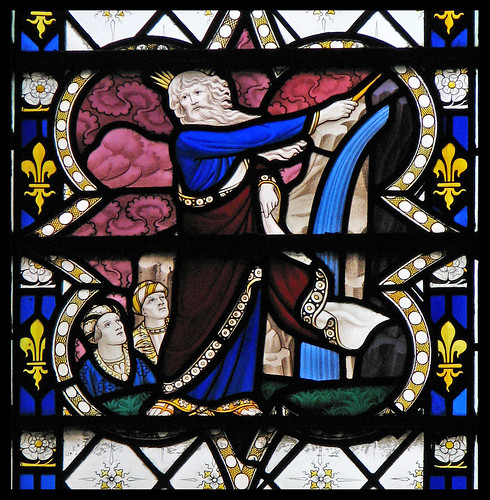
The message God gave by telling Moses to use his staff could not have been clearer. This was the same staff that God told Moses to use to turn the waters of Egypt blood red and undrinkable in one of the plagues God used to force Egypt’s king, the Pharaoh, to let His people go.

God was reminding Moses and the people of Israel that, no matter the crisis, His power was undiminished. He could provide for His people.

Water is still known to run through lime deposits in the Sinai Peninsula today. But in bringing water from this rock in Sinai, the Creator of the universe bent creation itself to His purposes for His people. The God Who raised His Son from the dead to give life to all who believe in Christ can do similar things for those who trust and obey Him today.

Read verse 7, please:
[Moses] called the place Massah and Meribah, because the Israelites quarreled and tested the Lord, saying, "Is the Lord among us or not?” 
Moses gave two names to the place. Massah means test. God had tested the Hebrews faith and the Hebrews had, contrary to God’s commandment, put God to the test. Meribah is translated as quarrel. But it has a more specific meaning; it’s the word used when a plaintiff sues someone else in court. The people thought they were bringing suit against Moses, but really their beef had been with God. Their question was, “Is the Lord among us or not?”

We may be tempted to ask that same question at times. I'll never forget a Saturday afternoon in my first parish when I was called to a hospital in Toledo, where a member of the congregation had been life-flighted. While using a torch to cut a barrel in half for some neighbor boys, the barrel had exploded and crashed into his skull. When I arrived at the ER, he looked like someone who had been through a battle. The doctors said that his prognosis was hopeless. His mother, a wonderfully faithful woman who had endured the deaths of her husband and a grown child already, kept asking of this calamity that had befallen this son, the father of small children, "How could God have let this happen?" Where had God been? she wondered. We've all been in that wilderness!*

But, as our Gospel lesson reminds us, the God Who caused water to spring from a rock in the wilderness has come in Jesus Christ, the Word made flesh, to be the living water from heaven!

Jesus refreshes and makes new the thirsty souls of all who trust in Him and live lives of repentance and obedience to Him.

May we turn each day to Jesus, even in the inconvenient wilderness times of our lives, and live! Amen

*I'm happy to report that the man in question not only survived, thanks to the prayers of many, but is strong and well to this day!
Sunday, March 6, 2011

Transfiguration: Really Seeing Jesus

[This was shared during worship with the people of Saint Matthew Lutheran Church in Logan, Ohio, earlier today.]

Matthew 17:1-9
I grew up in the city and because of that, believe it or not, I didn't see a sight that many of you may have seen many times in your life, until I was twenty-nine. It happened in Benzie County, Michigan, a place so small in population and size that it didn't even get its first traffic light until the late-80s. It's a place of real beauty with lakes and sand dunes that set next to Lake Michigan. Some people would say it's remote. Ann, Philip, and I spent a year there when I did my seminary internship. I'll never forget going to bed on the night we arrived, looking out the window, and seeing a shooting star flash across the sky. I'd had to get away from it all in order to see it, my first shooting star!

Maybe that was why Jesus took Peter, James, and John to the top of a mountain, as we’re told about in today’s Gospel lesson. Jesus may have wanted to give these three key followers, the ones He had chosen to be the leaders of His Church, the chance to get away from it all so that they could catch a clear vision of Who He is.

The account of what the three disciples saw that day also shows you and me Who Jesus can be for us.

And, what Peter, James, and John saw was spectacular! While standing on top of a mountain, Jesus was “transfigured...and His face shone like the sun, and his clothes became dazzling white.” Then, two Old Testament figures showed up. One was Moses, the one to whom God had given the Ten Commandments and who had been Israel’s leader out of Egypt, through the wilderness, about 1500 years before the birth of Jesus. The other was Elijah, a prophet whose ministry began about 870 years before Jesus was born and came to an end when God sent a chariot to taxi him to heaven.

The two of them represent the two great strains of Old Testament tradition: the law and the prophets. It was the Law and the Prophets that, hundreds of years before Jesus was born, pointed to His coming. Now, in a moment of fulfillment, Jesus stood talking with Moses and Elijah, underscoring that Jesus is the center of history and the bringer of all our best hopes.

Peter and the others were understandably impressed by this sight! Peter was so impressed, in fact, that he spoke up, foot firmly in mouth as always, and said, “Lord, it is good for us to be here; if you wish, I will make three dwellings here, one for You, one for Moses, and one for Elijah.” That word translated as dwellings could mean everything from huts to temples. I think it’s safe to bet that Peter was thinking in grander terms at that moment. He wanted to build three religious shrines.

It didn’t take long for his suggestion to be vetoed. A bright cloud came down from heaven and from it, a voice--the Voice, the same Voice that had confirmed that Jesus was the Son of God when Jesus was baptized at the Jordan River--said, “This is My Son, the Beloved; with Him I am well pleased; listen to Him!”

This command to listen to Jesus would have hit Peter like a punch to the gut. Just six days before, Peter had confessed his belief that Jesus was the Son, or the very reflection, of God, on earth to be our Savior and King. Jesus applauded Peter's answer. But then He told Peter and the others that He was to be crucified in Jerusalem and rise again on the third day after His death.

The very mention of Jesus being crucified had been repulsive to Peter. "This will never happen to You, Lord," Peter tried to tell Jesus. But Jesus, angered by this well-intentioned attempt to thwart Him in His mission of dying and rising for us, turned to Peter and said, "Get behind Me, Satan."

"Listen," Jesus was telling Peter, "to what I'm saying; not what you want Me to say!" This past week, our son Philip sent along a quote from a theologian he'd run across. It addresses preachers of God's Word: "You are required to believe, to preach, and to teach what the Bible says is true, not what you want the Bible to say is true." Jesus was emphatic that He would be our Savior in the way God chose, not the way we might prefer.

Now, on the mount of Transfiguration, after hearing the Voice from heaven command that he listen to Jesus, Peter may well have remembered the rebuke Jesus had issued to him six days earlier. Whatever was in his mind, Peter did the thing that made the most sense at that moment: He shut up and, along with the other two disciples, fell to the ground, understandably terrified.

Jesus went to them, touched them, and told them, “Get up. Don’t be afraid.” As the three lifted themselves off the ground and tentatively looked up, they discovered that, Moses, Elijah, the cloud, and the dazzling brightness were all gone. Only Jesus remained.

The same was true for those disciples as is true for us: When life frightens us or jolts us or throws us or hurts us, the only reliable helper guaranteed to be there is the compassionate God we know through Jesus Christ!

So, what was the point of this incredible incident? There were many points, I suppose. But I want to zero in on just a few this morning.

Point number one clearly was that Jesus is God the Son, in the flesh, come to earth with the full approval of God the Father. On the Mount of Transfiguration, He was revealed in the same way God was revealed on Mount Sinai to Moses and the elders of ancient Israel nearly fifteen centuries earlier.

Point number two is seen in God’s implicit rejection of Peter’s proposal to build three shrines. Several years ago, Ann’s mom took her and her family to the Mediterranean. Among their stops were Rome and the Vatican. I was interested in Ann’s impressions of the Vatican, with its grand basilica and priceless works of art. Ann, you know was an Art major who formerly worked for the art museum and the Arts Council in Columbus and is a talented artist herself. I shouldn’t have been surprised by her reaction, but I was. Like almost every person I’ve ever known to go the Vatican, my wife said that she was totally turned off by all the money spent on a religious shrine and wondered whether God was really glorified by it all.

It’s a good question. God isn’t necessarily glorified by buildings, icons, symbols, rituals, stained glass windows, or much-recited words. The Bible says that we followers of Jesus are temples of God's Holy Spirit, bought and paid for with the blood of Jesus Christ shed on the cross. In other places, it says that we’re to be living stones built on the cornerstone of Jesus Christ. Too often, our religious stuff may be nothing more than monuments to our own egos, designed to impress the world, not glorify God. But the God we know through Jesus Christ doesn’t build His kingdom with brick and mortar. He builds it in the lives of those who turn from sin and follow Jesus. That, I’m sure, is one reason that God cut Peter off when he offered to start building those three dwellings.

A third point that I think the disciples were to take from their experience on the mountaintop is maybe the most important one. It can be seen in that simple, moving moment when Jesus approached the frightened disciples, touched them, and told them to get up and not be afraid. The God we meet in Jesus Christ wants us to let Him into our lives. He wants us to welcome Him into all that we say and do and are each day. Jesus can do wonderful things when we do that.

The late E. Stanley Jones was a missionary, evangelist, and author. In one of his books, he tells the story of a man known to be, “the biggest grouch in Trenton.” One day, this man called someone he knew in another town and said, “All Trenton’s different---everybody’s different this morning since that meeting in the high school last night where we heard [the evangelist]. Of course, only I may be different, but all Trenton seems different.”

When we let God into our lives, everything is different. We have a different relationship with God and so, we can build different relationships with those around us. We can face life with hope and openness. We live in the confidence that our sins, which would otherwise earn us eternal separation from God, have been forgiven and that God will help us resist temptation in this world and that in eternity, living directly in the presence of God, sin will have no more power to mar our characters or our lives. We can be like the backwoods Christian I’ve mentioned before who said, “I ain’t what I want to be and I ain’t what I’m gonna be. But I thank God, I ain’t what I was!” “If anyone is in Christ,” the New Testament tells us, “there is a new creation; everything old has passed away; see, everything has become new.” God wants us to let Him into our lives so that we can be made new.

But I think there’s another reason God wants us to let Him into our lives. A pastor was driving along a country road, came to a corner, and saw an elderly woman walking along with a heavy load in her arms. He stopped beside her, rolled down his window, explained that he was the pastor of a neighboring church, and offered the woman a ride. She recognized him and said that she would love a ride. She climbed into the front seat and closed the door. As they pulled away, the pastor asked her, “Why don’t you put that load in the back seat?” “Oh, it’s kind enough of you to give me a ride. I can still carry this, though,” she said. They rode in silence for a time and then the pastor said, “Thank you for giving me an inspiration for my next Sunday message.” “How did I do that?” the woman wondered. “Well, I think our relationship with God is a lot like you and that heavy package you’re still holding in your arms. We trust God to get us through life, but not to help carry the burdens.”

I could almost write a book about all the times I thought for sure my life was going to go bust. But each time that happens, I’ve learned the importance of letting the God we know through Jesus into my areas of deepest concern. When we do that, our burdens become lighter and He shows us what to do, if we only let Him.

The God Who came to this world and touched the frightened disciples on the mountain, Who went to a cross and rose from a grave, wants to come to you this morning and each day of your life. He wants to help you carry your burdens. He wants to be your chief counselor, the One you turn to even when the whole world seems to have turned away. This week, why not make this your prayer at the beginning of each day?:
Lord Jesus, all day long, show me when I’m wrong. Affirm me when I’m right. Help me to make good decisions. Make me an agent of Your love. Today, I choose to let You into every moment of my life.
And then, like the disciples becalmed by Jesus on the mountain, face your day with confidence!

Tuesday, November 9, 2010

One Little Thing

It’s just one little thing.

In this case, the “one little thing” is the letter E.

In itself, it may be a minor matter.

But when you’ve watched the denomination you’ve loved and that you labored and prayed, in your own small way, to help birth, as it slides deep into error through a profusion of “little” things, one little thing is just one more thing.

And that one little thing points out how desperately the Evangelical Lutheran Church in America (ELCA) needs reform and renewal. (Which I pray for regularly.)

The E in question was called to my attention this past Sunday morning at breakfast. Our daughter, who was to read the Bible lessons in worship, was going through them one more time when she saw something she hadn’t noticed before.

Our lessons for each week, which are largely taken from the Revised Common Lectionary (RCL), are printed on bulletin inserts published by the ELCA Publishing House, Augsburg Fortress. The inserts are called Celebrate. On the inserts, each of the lessons is preceded by brief explanations. Those explanations, which are meant to be read during worship just before each of the lessons is read, are designed to give context to the Bible passages. They’re often helpful. (The explanations also appear in an annually published book called, Sundays and Seasons.)

Here’s what our daughter saw when she read the introductory explanation for this past Sunday’s first lesson, Daniel 7:1-3, 15-18:
The book of Daniel was written in the second century B.C.E., when the Syrian king Antiochus Epiphanes was severely persecuting the Jews. Daniel’s vision of the four beasts serves to proclaim the message that human kings will come and go, but the kingdom will ultimately belong to God and to God’s people.
“What’s this E doing after BC?” our daughter wondered.

“Is that a mistake?” my wife asked.

“No, it’s not a mistake,” I said. “But it shouldn’t be there!”

The old designations of B.C. (Before Christ) and A.D. (Anno Domini, Latin for Year of Our Lord), have been replaced in most contemporary scholarship and journalism by new designations. B.C.E. stands for Before [the] Common Era, while C.E. stands for [the] Common Era.

And you know what? I get that. Christians, varied and as numerous as we may be, members of the fastest-growing religion in the world, are still just one group among many who occupy this planet. We live in a world whose most enlightened people eschew cultural, racial, or religious imperialism, a world in which diversity is celebrated. And as a Christian, I embrace this trend. In fact, I pray for it to continue.

I think that this trend favors a project very dear to me, the central calling of all Christians: fulfilling the great commission Jesus has given to the Church. We’re to make disciplesfollowers of Christ—among all peoples.

In looking at history, I see that Christianity first spread not in the artificial hothouse of being the favored religion of an empire and not just in defiance of state condemnation and persecution, but in the context of theologically diverse societies, where people believed in many different gods and philosophies. History, to me anyway, shows that true pluralism and democracy always favor Christianity; when people are free to explore differing beliefs and come to know the relationship with God offered by Jesus Christ (as opposed to the "religion" offered elsewhere), following Christ will always look good. The more diverse, pluralistic, and free societies are, the more likely people are to become disciples of Christ.*

But, to me, pluralism and diversity are good for another reason. In a nutshell, Christians shouldn't even appear to be throwing their weight around, forcing their faith and worldview down other peoples’ throats. It isn’t right. It isn’t how Christ won disciples. It’s unloving. And it sets the cause of Christ back, not forward.

And so, though confessing that part of me cringes a bit every time I see “B.C.E.” or “C.E.” in books and articles from the fields of history, science, or the arts, I understand the use of these terms.

I accept it.

I even support it.

Nothing about the faith of Christians should be forced on others. People who subscribe to other religious convictions and people who have no religious convictions should not be forced to see history in terms of what happened before Christ or after He came to earth bringing the reign of God. Non-Christians don’t see what the theologians call “the Christ event,” as the center of human history.

But, here's the point: We Christians do! We see Jesus as the center of our history. We see Jesus as the center of all history!

When Christians read the Old Testament, we see the God of creation, by grace, calling a people—the Jews—to believe in Him, to become a light to the nations. We see prophecies pointing to the Messiah Who would come into the world to offer, by grace, new and everlasting life to all who believe in Him. For the Christian, everything before Christ, points to Christ.

In the New Testament, we see God becoming flesh, living in our world, being spurned by Jews and non-Jews alike, bearing the sins of the whole human race on His shoulders, dying for our sakes, and being raised to life again by the Father, so all who repent and believe in Jesus, will live forever with God. After Jesus died and rose, we believe, everything changed. The lives of all people were marked by new possibilities. "If anyone is in Christ, there is a new creation: everything old has passed away; see, everything has become new!" (2 Corinthians 5:17).

Christians believe that, after the fall of humanity into sin, all of human history has been the theater in which God has worked for the time—what the Bible calls God’s kairos time, as opposed to chronos, human or chronological time—when Jesus Christ would enter the world, bring the reign of God to all who believe, promise that one day, He will return and make all things new, and, in this intervening time--in these Years of Our Lord--will fill those who follow Him with the Holy Spirit, fortifying them for lives of loving God, loving neighbor, sharing Christ in words and actions, and living "in the sure and certain hope" that even though we die, we will still live with God for eternity.

The timeliness of God’s action in Christ is emphasized by the apostle Paul in the New Testament’s Romans 5:6: “…while we were still weak, at the right time Christ died for the ungodly…”

In another New Testament book, Hebrews, which is a sermon preached to Jewish Christians in the first century, we see this Christian confession of Christ as the center, the goal, and the fulfillment of human history, of cosmic history: “Long ago God spoke to our ancestors in many and various ways by the prophets, but in these last days he has spoken to us by a Son, whom he appointed heir of all things, through whom he also created the worlds” (Hebrews 1:1-2) (emphasis mine, of course).

Since we Christians believe that Christ is the center of history, why would a document prepared by a Christian denomination for use in Christian worship shy away from the use of the terms, B.C. and A.D.?

And why do some professors who teach at some seminaries of the ELCA “correct” students who use B.C. and A.D., rather than B.C.E. and C.E.?

Why should Christians be in any way wary of making the inherent confession of Christ as the center of all by using B.C. and A.D. in their own internal communications or in their public worship?

Why should we avoid declaring Christ’s Lordship? Jesus didn't avoid it!

He said, “I am the way, and the truth, and the life. No one comes to the Father except through me” (John 14:6).

He said, "The Father and I are one" (John 10:30).

He also said, “Everyone therefore who acknowledges me before others, I also will acknowledge before my Father in heaven; but whoever denies me before others, I also will deny before my Father in heaven” (Matthew 10:32-33).

And He said, “For God so loved the world that he gave his only Son, so that everyone who believes in him may not perish but may have eternal life. Indeed, God did not send the Son into the world to condemn the world, but in order that the world might be saved through him. Those who believe in him are not condemned; but those who do not believe are condemned already, because they have not believed in the name of the only Son of God” (John 3:16-18).

If Jesus claimed to be the Lord of everything, the center of history Who changes everything, the only access point to God, the liberator of humanity from the enemies of sin and death, then why should the Church claim anything less when speaking of Him? Why should we be shy about Christ's Lordship?

Is this “shyness” mere political correctness?

Is it absent-minded acquiescence to a cultural norm?

Or is there something more sinister about it?

Whatever the answers to those questions may be, the “little things” keep piling up in the ELCA. The Lordship of Jesus and the truth of God’s Word seem denied in numerous little ways all the time among us. When it doesn’t make me mad, it makes me sad. Then it makes me pray. (And write blog posts.)

You see, it isn’t really such a little thing, after all, because, no matter how many little things get piled on, the Bible still says of Jesus, the center of history, “There is salvation in no one else, for there is no other name given among mortals by which we must be saved” (Acts 4:12).

It may be a single letter E. But its addition to B.C. says a lot about the state of the ELCA and what at least some of its most influential people really think about Jesus.

The early Church faced persecution and death to declare that Jesus is Lord. Many Christians in many parts of the world today face the same threats for their faithfulness to Jesus as Lord. So, why can’t we North American Lutherans own Jesus’ Lordship in the comfort and safety of our sanctuaries as we worship? That’s a big question. And every member of the ELCA must, I think, eventually answer it.

*I speak from personal experience. For about a decade, I considered myself an atheist, but, in a pluralistic society in which I was free to explore other possibilities, Christ wooed me into relationship with Him.

Sunday, September 26, 2010

Your Money or Your Life

[This was shared during worship this morning with the people of Saint Matthew Lutheran Church in Logan, Ohio.]

1 Timothy 6:6-19
It may be an example of holy coincidence, what someone has called God-incidence, that on the Sunday following the premiere of the movie, Wall Street: Money Never Sleeps, our Bible lessons for the day warn us of the dangers to our very souls represented by the love of money. Gordon Gekko, the main character played by Michael Douglas in this long-anticipated sequel, is known for his tagline in the first film: “Greed is good.” Jesus, in our Gospel lesson, the prophet Amos in the first lesson, and the apostle Paul in the second, all tell us today that “Greed is not good.”

But more than that, they say, “Greed for wealth can rob you of life for all eternity. Watch out for greed!”

The most tempting thing for us to do when we encounter Bible passages like these is to ignore them, thinking that they don’t apply to us. We’re not millionaires or billionaires, after all. There’s little chance of our getting trapped in the snare represented by the greed for wealth, right? Don’t be so sure!

There’s a number that development experts and even the CIA use called PPP. It stands for Purchasing Power Parity. It measures the median household incomes of every country in the world. This is the average income and purchasing power of all nations' homes, measured in US dollars. The United States ranks 11th in the world in median household income: $46,000. If that seems high, it may be because the median household income here in Hocking County is $40,000, about the same as Canada, which ranks 27th in the world.

All through the list, there are countries where people enjoy comfortable life-styles, yet don’t rank that high: the United Kingdom is 35th, Japan is 40th, Saudi Arabia is 61st. The point is this: By the standards of the world, many of us in this sanctuary this morning are incredibly wealthy. While impoverished people may fall prey to making gods of money, ignoring Paul’s warning in our second lesson that “the love of money is a root of all kinds of evil,” it’s far more likely that those of us who get regular paychecks will do so.

Like the addict who finds that he needs a little more today in order to get the same buzz he got yesterday, the love of money can become an absorbing passion that pushes God clear out of our lives. God forbid!

Please pull out your Celebrate inserts and look at our second lesson. Read along with me silently as I read the first five verses:
Of course, there is great gain in godliness combined with contentment; for we brought nothing into the world, so that we can take nothing out of it; but if we have food and clothing, we will be content with these. But those who want to be rich fall into temptation and are trapped by many senseless and harmful desires that plunge people into ruin and destruction. For the love of money is a root of all kinds of evil, and in their eagerness to be rich some have wandered away from the faith and pierced themselves with many pains.
There is nothing wrong with wealth. The love of wealth though, can cause us to make money our god, even though it has no capacity to give us life beyond the grave. Greed for gain, rather than a consuming desire for God, can make us think that the money we have earned with the bodies and the minds God has given to us, is ours. But this isn’t true.

First Corinthians 6:19-20 says, “Do you not know that your body is a temple of the Holy Spirit within you, which you have from God, and that you are not your own? For you were bought with a price; therefore glorify God in your body. ”

All who are baptized and confess Jesus as their Lord have been bought out of sin and death through the death of Jesus on the cross. We belong to God. So does our money. In one of our hymns, we tell God that all that we have is “a trust, O God, from Thee.”

Last Sunday, during worship we prayed for those effected by the tornadoes that ripped through southeastern Ohio a week-and-a-half ago. As I greeted folks after worship, one of our members said to me, “Pastor, if you learn of anybody without a home, let me know. I have a place people could use if they need it.” When our desires are focused on God, greed is pushed from our minds in ways that cause a passion for God and God's will that supplants the greed for financial gain. God helps us then to use whatever wealth we do have for His purposes.

Verse 11 in our lesson says: “But as for you, man of God, shun all this [that is, shun greed]; pursue righteousness, godliness, faith, love, endurance, gentleness.” The apostle Paul wrote the letter of 1 Timothy to a young pastor named Timothy in about 64AD. Paul meant for his words to be a primer on how to be a pastor. Shun the love of money, Paul tells Timothy.

It’s a tragedy when pastors become obsessed with money, when they confess Jesus with their mouths, but declare a greater faith in money with their lives. Pastors ought to be treated fairly by their congregations, of course. Paul says elsewhere in 1 Timothy, “The laborer deserves to be paid.” But, there are some clergy who seem to think that because they took a four-year Master’s degree after graduating from college, they deserve big bucks and fine things. This appears to be a bigger problem in the United States than it is in other countries where people are maybe, less addicted to wealth.

The Lutheran churches in Australia long ago instituted what I think is a great policy: Every single pastor, no matter the size of the congregation, receives the same salary, with adjustments for expenses like having families, living in more expensive communities, or extraordinary medical expenses. Each time this has been proposed at the conventions of Lutheran bodies in North America, it’s met defeat. In twenty-six years, I’ve never asked for a raise and I never will. This isn’t because I’m so virtuous—I’m a sinner like everybody else. It’s because I don’t want to give greed or the devil footholds in my life. I want to rely on the provision of the God I know in Jesus Christ and not on my capacity to shrewdly negotiate for or "guilt" people out of more money, which may in the end, only cause me to wander away from God, making me useless to God or to the congregation I serve as pastor.

Verses 12 to 15 say:
Fight the good fight of the faith; take hold of the eternal life, to which you were called and for which you made the good confession in the presence of many witnesses. In the presence of God, who gives life to all things, and of Christ Jesus, who in his testimony before Pontius Pilate made the good confession, I charge you to keep the commandment without spot or blame until the manifestation of our Lord Jesus Christ, which he will bring about at the right time—he who is the blessed and only Sovereign, the King of kings and Lord of lords.
Before Pilate, the Roman governor, Jesus confessed that He was the Lord and King of the world, God in the flesh, making no attempt to deny that He had made this confession before. If we were baptized as infants, our parents and sponsors made this same confession at the baptismal font. If we were baptized as adults, we made this confession ourselves before water was splashed on our heads. When we were confirmed, we made this confession. And Timothy, like all other pastors over the past 2000-plus years, reiterated that same confession. Paul is telling us today to fight the temptations that exist within all of us to betray Jesus by fudging on our confession that Jesus is the only Sovereign of the universe.

This is the confession that Paul makes in a famous passage in Romans: "If you confess with your lips that Jesus is Lord and believe in your heart that God raised him from the dead, you will be saved." Keep this good confession not only with your mouth, but also with your life, Paul tells Timothy in today's lesson. His words are for us, too.

In verse 16, Paul says of Jesus: “It is he alone who has immortality and dwells in unapproachable light, whom no one has ever seen or can see; to him be honor and eternal dominion. Amen.”

Please notice: Only God is immortal; human beings die. Life is not our right, something God owes to us. Life comes only from the One immortal being in the universe. And new life only comes from Jesus Christ to those who believe in Him. "If anyone is in Christ Jesus," the Bible tells us, "there is a new creation: everything old has passed away…”

It’s our mission as people saved by the grace of God given to us through Jesus Christ to share this good confession with others. We are to be driven by love of God and love of others to tell everyone the truth about sin and grace, and to call them to make the same good confession God has used to save us from sin, death, and hell.

 Finally, read along with me the final part of our lesson, verses 17 to 19. Paul is back to talking about money. But now he tells Timothy what he should teach the people of his congregation about the proper use of money:
As for those who in the present age are rich, command them not to be haughty, or to set their hopes on the uncertainty of riches, but rather on God who richly provides us with everything for our enjoyment. They are to do good, to be rich in good works, generous, and ready to share, thus storing up for themselves the treasure of a good foundation for the future, so that they may take hold of the life that really is life.
The bottom line is simple, really. We can either be greedy for wealth or hungry for God. The dividends paid by wealth end at the cemetery, but those who “take hold” of the God we know in Christ, take hold of real life, a life of meaning here and a life with God in eternity.

In a very real sense, when it comes to being greedy for more than our daily bread, we face the choice given by villains in lots of old movies: “Your money or your life.” Today, our lesson from God’s Word tells us that whenever faced with that choice--our money or our life--God desperately wants us to choose life, the eternal life that only an immortal God Who has died for us and risen again for us can offer.

Money is nice to have, but money can’t give us life; Jesus can. Choose passion for Jesus over greed for financial gain.

Today—every day—choose Jesus.

Wednesday, September 15, 2010

Needed: Holy Discontent and a Dirty Christian Word

Revival is a term that some, both inside and outside the Church, may see as sort of a Christian "dirty word."

But revival is a Biblical concept that refers to what happens to individuals, communities, churches, or nations when they turn to Jesus Christ for forgiveness and new life.

Revival, new life with God, is something that can happen to people who have long warmed church pews, but have lost sight of Jesus, once their "first love."

Revival also happens to those who have never known or trusted in Christ, who come to worship and trust Him as their only God and Savior.

The word revival literally means, of course, to be made alive again. Revival is what happened to the Prodigal Son in Jesus' famous parable. The younger son in Jesus' story, you'll remember, took the inheritance the father had always planned on giving to him and decided to misuse his freedom as license for sin. Things didn't go well. Mindful that life with his father--representative of God--had given him both the freedom and the power to be his best self, the son set out for home, his only goal to ask for his father's forgiveness and seek employment with him as a hired-hand. He felt worthy of nothing more than this.

But when the father sees his son, he welcomes him happily and throws a party for him. The father's other son--representative for us today of good religious pew-warmers whose relationship with God is lukewarm, at best--becomes angry with his father for forgiving the younger son. He even refuses to join the welcome home party for the younger son. The father begs him to join in, explaining, "...we had to celebrate and rejoice, because this brother of yours was dead and has come to life; he was lost and has been found."

Jesus says that "there is joy in the presence of the angels of God over one sinner who repents," that is,  one person who turns from sin and to the God made known in Jesus. When that one person repents and trusts in Christ as their God and Savior, that one person is revived--made alive again.

Elsewhere, the New Testament says that "...if anyone is in Christ, there is a new creation: everything old has passed away; see everything has become new!" (2 Corinthians 5:17)

General revival, such as was experienced in the United States during the Great Awakenings in the 18th and 19th centuries, begins with individuals and churches confessing their sins in more than pro forma ways to God--and in some cases, to each other. Confession of this kind authentically owns its need of the power for living free from the sin and the death we can't get free of on our own. Revived people relish the Biblical promise: "There is therefore now no condemnation for those who are in Christ Jesus our Lord!" (Romans 8:1).

Humility and honesty before God, a willingness to trust God more than we trust the sins we love to commit, can ignite a contagious general revival in which hundreds and thousands of people turn in faith to Christ and find their lives, their churches' lives, and the lives of those they touch in the community and world with the Good News of new life that comes only through faith in Christ.

This is how revival has always come. In Old Testament times, God told Solomon, king of God's people, Israel, "If my people who are called by my name humble themselves, pray, seek my face, and turn from their wicked ways, then I will hear from heaven, and will forgive their sin and heal their land" (2 Chronicles 7:14).

Our land--where only 17% of those identifying themselves as Christians bother to worship on any given week--and our whole world, need the healing, the revival, that Christ can bring.

This can happen. Someone once said that if you want to know how revival begins, get down on your knees, draw a circle around where you're kneeling, then confess your sins and ask God to help you trust in Christ alone. God will then begin revival within that circle.

In a real sense, revival begins when we're dissatisfied with the way things are. I call this holy discontent.

When we have holy discontent, we're not pleased by our own lack of love for God and others and we long to live differently. We want to be more like that person we're always trying to prove we are to others. When we have holy discontent, we hunger for--we are desperate for--God. When we have holy discontent, we will be incapable of trusting God, but we want to. We're like the man who said to Jesus, "I believe; help my unbelief." And just as Jesus answered that man's prayers, in spite of his feeble, weak faith, Jesus will answer the prayers of all who are willing to trust in Him, even if their trust is weak or next-to-nonexistent.

God doesn't sit in heaven waiting for us to become good enough before He hears our prayers. "The Lord is gracious and merciful, slow to anger and abounding in steadfast love," the Bible tells us repeatedly. God knows the intentions of our hearts and understands how hard it is for us to trust in Him. But His promise, again found in several Biblical passages, is that all who call on His Name will be saved. All of this is why David wrote back in Old Testament times: "As a father has compassion for his children, so the Lord has compassion for those who fear him. For he knows how we were made; he remembers that we are dust." God will never turn a deaf ear to anyone who genuinely wants to want Him, who genuinely wants to trust, wants to turn from sin. Blessedly, if we give God an inch, God will take a mile. That's a great thought to my mind!

Listen: Holy discontent comes from God.

It's caused by the holes in our souls that can only be filled by Jesus Christ.

It's foisted on you by the Holy Spirit calling you to the daily habit of personal repentance and renewal.

When we experience holy discontent, a good thing to do is to go through the Ten Commandments and Martin Luther's explanation of them (or any other great Christian teacher's explanations of the Commandments), to hit our knees, to repent for our violations of each commandment, and to experience the forgiveness that can come to those who pray in Jesus' Name.

In other words, revival begins when we honestly and forthrightly heed Jesus' call to repent and believe in the good news that God so loved the world that all who entrust themselves--including their sins--to Him will not be separated from God for eternity, but have everlasting life.

The joy that comes to people who are reconciled with God through Christ causes them to want to share that revival that comes from God with others. They're like Peter and John, early followers of Jesus who were ordered by religious authorities to stop telling others about Jesus' life, death, and resurrection and the good news of new life given by all who turn to Christ. In the face of the threats, they said, “Whether it is right in God’s sight to listen to you rather than to God, you must judge; for we cannot keep from speaking about what we have seen and heard" (Acts 4:20).

Having personally experienced the forgiveness and new life they knew that the crucified and risen Jesus wanted to give to all people, Peter and John felt an overpowering need to share Christ with others. "This Jesus," they told the religious leaders who threatened them, "is 'the stone that was rejected by you, the builders; it has become the cornerstone.' There is salvation in no one else, for there is no other name under heaven given among mortals by which we must be saved" (Acts 4:11-12).

Once revival starts to happen inside of you, it's bound to show up outside of you, and nothing and no one can stop it...not even you yourself. "If you're happy and you know it, then your face will surely show it..." as the Sunday School song puts it.

But it's this precise insight that ought to rouse our holy discontent...and our concern. As Tom Phillips writes in his 1995 book, Revival Signs: Join the Spiritual Awakening:
People today want to know about Christ more than Christians want to tell them about Him.
This sad state of affairs is even worse today than it was when Phillips wrote those words fifteen years ago.

A Florida pastor gains national prominence not because he and his flock are sharing the good news of Jesus, or because they are repenting and experiencing the revival the Holy Spirit sends to people who humble themselves and repent in Jesus' Name. Their prominence comes from touting a plan to burn the Koran, an act irrelevant to their mission as a church and hardly expressive of the gentleness and reverence with which we Christians are told to share our faith. Meanwhile, the world is desperate for the revival only Jesus can bring!

A denomination, which has shrunk by over a million members and 1000 congregations in the past twenty years, my own Evangelical Lutheran Church in America (ELCA), becomes more involved with lobbying the government in Washington and the acceptance of heresies designed to court the favor of the world while ignoring the will of God, than it is with sharing Jesus. (Of course, it can't credibly share Jesus anyway, so long as it remains rebellious against Jesus and against God's revealed will in God's Word.) Meanwhile, the world remains desperate for the revival only Jesus can bring!
 
But we shouldn't give in to hopelessness! There's no good reason to do so. After all, in Christ, we know that God is bigger than all that daunts us or threatens to rob us of the joy Christ came to give to us. We need to pay attention to our discontent and bring it to God.

Discontent among Christians can lead us to repentance and to renewal, which in turn can lead us to share our faith in Christ with others. Jesus' plan all along has been to use people desperate for Him and so desperate in their love for others that they will obey His great commission--to make disciples of all nations, to lovingly woo others into a relationship with Christ.

The person who lets God into their lives through worship and fellowship with Christ's Church, personal confession, regular Bible reading, grateful reception of Holy Communion--Christ's body and blood--each time it's offered, and intercessory prayer for others, can experience revival.

It will happen first in themselves.

And then, through the Holy Spirit, they'll follow Scripture's direction to "always be prepared to make [a defense of their faith in Christ] to anyone who demands from you an accounting for the hope that is in you." And they will be able to do it "with gentleness and reverence" (1 Peter 3:15-16).

In his phenomenal little book, The Church God Blesses, Pastor Jim Cymbala writes:
Every revival in church history has been started by pastors and believers who became deeply dissatisfied with the moral and spiritual climate around them. They knew from Scripture that God has something better for his people. All the great missionary movements have been spawned by men and women who became desperate to see God's kingdom extended to new regions and to those who had not yet heard about Jesus. In fact, every time people really pray, they are believing that God by his divine power can change what is into something better.
Do you feel discontent with yourself, your family, your church, your community, our world?

Turn to God. Trust in the God Who makes this promise to those who want Him:
Seek the Lord while he may be found, call upon him while he is near; let the wicked forsake their way, and the unrighteous their thoughts; let them return to the Lord, that he may have mercy on them, and to our God, for he will abundantly pardon. For my thoughts are not your thoughts, nor are your ways my ways, says the Lord. For as the heavens are higher than the earth, so are my ways higher than your ways and my thoughts than your thoughts. For as the rain and the snow come down from heaven, and do not return there until they have watered the earth, making it bring forth and sprout, giving seed to the sower and bread to the eater, so shall my word be that goes out from my mouth; it shall not return to me empty, but it shall accomplish that which I purpose, and succeed in the thing for which I sent it. (Isaiah 55:6-10)
  • Confess. 
  •  Trust. 
  •  Pray. 
  •  Get to know God better through God's Word, the Bible. 
  •  Share the good news of new life through Jesus. 
 Revival can happen. Every Christian should want it to happen.

Are you content with the way things are or do you long for the better--and everlasting life--God wants to bring to all people? God can answer the prayer that many of us sing on Pentecost Sunday, when we ask the life-giving breath of God to make life new, to revive us, through Jesus Christ:
Spirit, Spirit of gentleness
Blow thro' the wilderness
calling and free.
Spirit, Spirit of restlessness
stir me from placidness
Wind, wind on the sea
We dare not be placid! There's a dying world that needs new life. God is looking for people who will daily surrender to Christ and ask God for nothing more than the privilege of sharing the new life that comes from Christ with others.

Revival can start within us and take in all the world. May our prayerful surrender to Jesus Christ be the start of a new great awakening!


Monday, September 13, 2010

'Today is a New Day'

[That's the title of a fantastic message presented by my colleague, Pastor Glen VanderKloot. It's worth the time it will take you to read it. Glen is pastor of Faith Lutheran Church in Springfield, Illinois. You can receive his daily emailed inspirations by going to this web site and following the prompts.]
Today is a new day!

Yesterday is over. Yesterday does not matter.  It does
not matter how often you messed up.  It does not  matter
how badly you messed up.  The past is past.  There is
nothing you can do about it, other than learn from it
and let it go.

It is essential that we learn to let go of yesterday. 

Joyce Chapman wrote...

    If you're still hanging onto a dead dream of
    yesterday, laying flowers on its grave by the hour,
    you cannot be planting the seeds for a new dream
    to grow today.

We have to let go.  Paul understood this.
He wrote to the Philippians...

    This one thing I do: forgetting what lies behind
    and straining forward to what lies ahead.
    Philippians 3:13 NRSV

That does not mean we should forget good memories. 
We want to treasure those good memories in our hearts
and minds forever.   It does not mean to forget lessons
learned. Those lessons will keep us from making the
same mistakes over and over again.  Gary Marshall said...

    It's always helpful to learn from your mistakes
    because then your mistakes seem worthwhile.

Let go of all the things from yesterday that drag you down.
Let go of all the things from yesterday that hold you back.
Let go of all the things from yesterday that cause you
    shame and embarrassment.
Let go of all the things from yesterday that cause
    you guilt.
Let go of all the things from yesterday that leave
    you with regret.

Today is a new day!  Let us join with the Psalm writer
and say...

    This is the day that the LORD has made;
    let us rejoice and be glad in it.
    Psalm 118:24 NRSV

We can let go of yesterday's guilt and regrets. 

We can let go of guilt and regret because Jesus has
taken our guilt and regret with him to the cross at
Calvary.  Jesus has set us free.  We are forgiven. 
The slate is wiped clean.  God said through the
prophet Jeremiah...

    These people that I've saved will start out
    with a clean slate.
    Jeremiah 50:18  The Message

We have a clean slate.  Every day we can make a fresh
start and a new beginning.

There are some clergy that who will tell you that God is
keeping a record of everything wrong you have ever done,
ever said or ever thought. Nothing could be further from the truth.
Satan might be keeping track, but not
God.  Instead, God speaking through the prophet
Isaiah, says...

    I, I am the One who erases all your sins,
    for my sake; I will not remember your sins. 
    Isaiah 43:25 NRSV

God erases all our sins. God no longer remembers our
sins.  If God has let go of our sins, surely we too
can let go instead of being crippled by guilt and regret.
   
Today is a new day!  Let us join with the Psalm writer
and say...

    This is the day that the LORD has made;
    let us rejoice and be glad in it.
    Psalm 118:24 NRSV

The Father celebrates when his children come home.
So welcome home! 

In the Parable of the Prodigal Son in Luke 15, the
younger son asks for his inheritance early. After
he receives it from his father, he takes off to a
foreign and exotic land.  He is the life of the party
until his money runs out.  Then he is stuck with the
lowest of the low jobs for a Jewish man:
feeding the pigs. 

Luke tells us that suddenly it dawned on him that his
father's servants have it better than he does.  So
he decides to go home.  He rehearses his apology to
his father and even offers to give up the rights
of a son and instead be a servant.

What kind of reception does he get? Jesus tells us...

    But while he was still far off,
    his father saw him and was filled with 
    compassion; he ran and put his arms around him
    and kissed him.
    Luke 15:20 NRSV

Joy, celebration, compassion and love - that was
his father's reaction to his homecoming.  The father
welcomed him home, not as a servant, but as the long
lost son who has come home.  The Father explains...

    Let us eat and celebrate; for this son of mine
    was dead and is alive again; he was lost and
    is found!
    Luke 15:23-24  NRSV

What did the father and all of his household except
the older brother do?

    And they began to celebrate.   
    Luke 15:24 NRSV

Our Father in heaven is filled with joy, compassion,
and love when any of his wayward children come home. 
When we come home, it is a time for celebration.
When we come home, it is party time.

So, believe that you can make a fresh start and do it. 
That is what God offers to us.  Paul writes...
   
    Now we look inside, and what we see is that anyone
    united with the Messiah gets a fresh start,
    is created new.
    2 Corinthians 5:16 The Message

It does not matter what has happened in the past. 
You can have a fresh start, a new beginning.  Paul
explains further...

    If anyone belongs to Christ, there is a new creation.
    The old things have gone; everything is made new!  
    2 Corinthians 5:17  NCV
The old is gone.  Everything is made new.  You can make
a fresh start.

A sculptor ruined a huge piece of beautiful Carrara marble.
It was left in the courtyard of the cathedral in Florence,
Italy, for almost a hundred years. Artisans thought it
was beyond repair.

In 1505, a young sculptor by the name of Michelangelo
was asked if he thought anything could be done with
"The Giant." He measured the block and carefully noted
the imperfections caused by the bungling workman of an
earlier day. To his mind came the image of the young
shepherd boy David. He carefully made a sketch of that
biblical character as he envisioned him. For 3 years
he worked steadily, his chisel skillfully shaping the
marble into a beautiful towering figure, 18 feet high
and weighing 9 tons.

Beginning fresh often is a product having the vision
to see beyond the ordinary and into the extraordinary.
The Bible is full of stories of people and nations who
were able to envision what could be. 

Hara is a mother and recovering addict who has been
incarcerated multiple times on drug-related charges.
"I never committed a crime sober," she says. She used
alcohol and drugs on and off for 22 years to help her
cope with a very painful life.

Hara has made a fresh start. You can too. On February
20 this year, Hara was released from prison. Again.
This time, though, she was determined to do something
different. To help her in her quest for a new life,
she sought the help of Connections, a program of
Lutheran Social Services of Illinois. Connections
works with incarcerated women and their families,
as well as women re-entering the community following
prison.

The Connections staff knew that Hara was serious
about change and willing to work at it. The people
at Connections went to work helping Hara in her
transition from prison to the free world.

The staff helped her get a bus pass, put together
her resume and find work.

Hara, who is in recovery from her addiction,
insists that there are people like her who want
to change. And that once they're able to change,
they can reach out to others who are struggling
-- in a way that others who haven't been through
these hardships just can't.

That's exactly what Hara does. While going to college,
she works at Project Success, which helps people,
including those recently released from prison, make
a way to go to college.

She's also a volunteer for the Department of Women's
Justice Services, part of the Sheriff's Department.
A passionate speaker, Hara talks to incarcerated women,
women on furlough, social workers, youth and church
groups.  She tells those just getting out of prison...

    Never give up. Whatever your problem is,
    I say it's not who you are.     You can change.
    You can start life over. 

Today is a new day!  Let us join with the Psalm
writer and say...

    This is the day that the LORD has made;
    let us rejoice and be glad in it.
    Psalm 118:24 NRSV
It is time for a fresh start and a new beginning. 
Will you make one? 
Amen