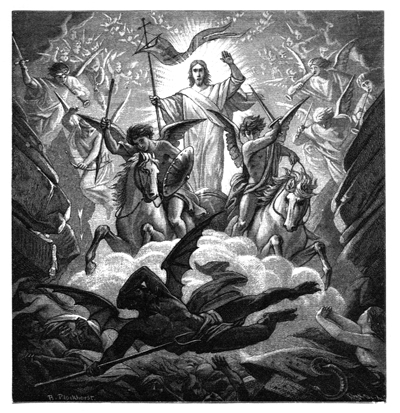
In the Apostles' Creed, we Christians confess that after dying on the cross, Jesus "descended into hell." This, of course, is the logical conclusion of Jesus' self-sacrifice. He was paying the full price for human sin, bearing in Himself the full punishment our sins deserve in spite of His complete sinlessness. This necessarily meant that after Jesus died, He had to go to hell.
When people die naked in their sin, without the protective armor of God's grace given to all with faith in Christ, hell, separation from God, is their destination. Jesus warned of this when He told Nicodemus, "Those who believe in [Jesus] are not condemned; but those who do not believe in Him are condemned already, because they have not believed in the name of the only Son of God" (John 3:18).
Jesus made His atoning sacrifice complete by sharing not only in death, but also in the experience of hell itself. 1 Peter 3:18-20 says:
For Christ also suffered for sins once for all, the righteous for the unrighteous, in order to bring you to God. He was put to death in the flesh, but made alive in the spirit, 19in which also he went and made a proclamation to the spirits in prison, 20who in former times did not obey, when God waited patiently in the days of Noah, during the building of the ark, in which a few, that is, eight persons, were saved through water.
(Peter goes on, by the way, to speak of baptism as the means by which the old self is drowned and God's Holy Spirit brings new life in Christ.)
We remember Maundy Thursday as the day on which Jesus, with His face set toward dying for us, instituted the Sacrament of His Body and Blood (Holy Communion, The Lord's Supper, The Eucharist) and gave a new command to His Church: that believers love one another as Christ loved us, sacrificially.
We remember Good Friday as the day on which sinless God-enfleshed died in our places on the cross, so that all who believe in Him will find their sins covered by His life-giving blood and grace, His undeserved favor.
We remember Easter Sunday, of course, as the day when Jesus rose from the dead, claiming eternal life with God for all who believe in (that is, entrust their lives to) Jesus Christ.
We should also remember Holy Saturday, the day on which Jesus bore the full punishment our sins merit, descending into hell, but at the same time, proclaiming that God's plan had been fulfilled; the perfect sacrifice had been offered; the powers of the devil, evil, and hell had been crushed for all eternity. The devil, evil, and hell still wreak havoc in this world. They will until the day when Christ returns to fully establish His kingdom. But they are in their death throes. Christ has conquered!
[I originally wrote and posted this in 2008. But it seems worth repeating on this Good Friday.]
"Why do we call this 'Good' Friday?"
That's what an inquisitive second-grader asked me once.
It's a sensible question. The day we commemorate as Good Friday, after all, brought multiple tragedies.
Good Friday, which this year falls on April 22, is when Christians all over the world remember the day when Jesus of Nazareth, the One we believe was the Messiah (that is, the Christ, God's Anointed King of kings) was crucified.
The Bible says that Jesus' death on a cross resulted from the rejection of the entire world, at least the entire world as known by Jesus' first-century followers: the people of God (the Judeans) and everybody else (the Gentiles), represented by the preeminent power of the day, the Roman Empire.
The prologue to the Gospel of John reminds us that Jesus was more than a human being. He was God enfleshed. Yet the whole world rejected Jesus. "He was in the world," John writes, "and the world came into being through him; yet the world did not know him. He came to what was his own [the world He made], and his own people [Jews and Gentiles] did not accept him." (John 1:10-11)
The day we call Good Friday then, wasn't only tragic because the sinless God and Savior of the world died a horrible death. It was also tragic because a human race in need of salvation rejected God's outstretched hand, spurned the love of God, turned away from God Himself.
But there is an even deeper layer of tragedy to the day. God the Father, the first Person of the Trinity, perfect and sinless, was separated from Jesus in those horrible hours when Jesus hung on the cross.
Why? Paul writes in the New Testament, "For our sake he [God the Father] made him [Jesus] to be sin who knew no sin..." (Second Corinthians 5:21). Jesus, in spite of His sinlessness, bore the weight of our sin. He embodied the sins of us all, taking our rightful punishment for sin. (Romans 6:23 tells us that "the wages of sin is death.")
God, in His holiness, cannot abide the mere sight of sin and on the cross, Jesus bore the total weight of all human alienation from God, all human distrust of God, and every misdeed, small and large, that's ever been committed or ever will be committed by the whole human race. God the Father simply couldn't look at Jesus on the cross because, utterly sinless though Jesus was, He voluntarily embodied our sin and took our punishment for it there.
There is a reason that Jesus did all this, which I'll address momentarily. But that reality can't in any way erase the awful agony Jesus endured, feeling utterly abandoned by the Father as He died on the cross. No more poignant words have ever been uttered on this planet than those Jesus cried out near the end of His earthly life, "My God, My God, why have You forsaken Me?" (Matthew 27:46)
So, if Good Friday remembers that Jesus was rejected by the whole world and abandoned by God the Father, what could possibly be good about it?
That goes back to the reason that Jesus had for going to the cross. You see, the world thought in killing off Jesus, it was done with Him. Some of the more perceptive people who wanted Jesus dead understood that He was God and so thought that in killing Him, they were getting rid of God and God's rightful authority over their lives (our lives, too). (Jesus told a parable showing that this was the motive of many who sought His death, here.)
In short, they thought that Good Friday was all about what they did to Jesus. The subject of their sentences about Jesus' crucifixion would have been themselves. "We crucified Jesus," they would claim. Herod, the puppet king of Judea, known to have been a particularly violent, sadistic, and loathsome character, might have said, "I ordered Jesus' abuse. He was under my control." Pilate, the Roman governor, would have told anyone who would listen, "I exercised my power and had Jesus crucified."
But, in fact, the events of Good Friday unfolded precisely as God wanted them to happen. Jesus came into the world to die for us. That was always the plan.
This is something that the wise men from the East seemed to know even when Jesus was a baby. Among the gifts they brought was myrrh, an aromatic resin used to anoint the dead, hardly a fitting present for a baby when you think about it, a bit like giving a gift certificate from a casket factory at a baby shower.
After He began His ministry, Jesus made it clear that He was intent on going to a cross to His disciples. You may remember what happened the first time Jesus talked about this:
...Jesus began to show his disciples that he must go to Jerusalem and undergo great suffering at the hands of the elders and chief priests and scribes, and be killed, and on the third day be raised. And Peter took him aside and began to rebuke him, saying, “God forbid it, Lord! This must never happen to you.” But he turned and said to Peter, “Get behind me, Satan! You are a stumbling block to me; for you are setting your mind not on divine things but on human things.” (Matthew 16:21-23)
In the night before His crucifixion, Jesus was brought to Pilate for questioning. But Jesus refused to answer. That resulted in this exchange between the two of them:
Pilate therefore said to him, “Do you refuse to speak to me? Do you not know that I have power to release you, and power to crucify you?” Jesus answered him, “You would have no power over me unless it had been given you from above... (John 19:10-11)
Jesus says of His life:
No one takes it from me, but I lay it down of my own accord. (John 10:18)
We call this day Good Friday because on the first one some two-thousand years ago, Jesus fulfilled God's plan. He took our punishment for sin and later, rose from death so that all who repent of sin and entrust their lives to Him will live forever.
So, the wages of sin is death, "but the free gift of God is eternal life in Christ Jesus our Lord." (Romans 6:23)
Good Friday is good because, just as it was the route through which Jesus moved to Easter, it's also the route through which all who believe in Him share in His Easter victory! It's because of what Jesus did on Good Friday for us, followed by God the Father raising Him from the dead, that you and I can confess our belief in the "forgiveness of sins, the resurrection of the body, and the life everlasting." Amen!
[This was shared during worship with the people of Saint Matthew Lutheran Church in Logan, Ohio, this morning.]
Isaiah 2:1-5 Advent, which begins today, is a time for getting ready. Just as many are working themselves into frenzies preparing for Christmas, Advent asks us, “Are we ready, not for Christmas Day, but for the advent of Jesus, for the appearing of Jesus?”
Are we ready for Jesus to show up to bring an end to this world of sin and death and establish a new heaven and a new earth free of sin and death and grief?
Are we ready to meet Jesus face to face should our lives end before Jesus returns?
The last thing that any human being should want is to be ready for Christmas or for things like tomorrow’s special project, school assignment, or big game, yet not be ready to meet Jesus.
So, are you ready?
Each of our appointed lessons for this first day of the new Church Year can help us to be ready for Jesus’ return or, should we die before His return, for the moments we first see Jesus face to face. (1)
Please pull out the Celebrate inserts for this morning. Our first lesson is Isaiah 2:1-5. Verse 4 is probably the most famous passage here. It's a verse that promises that, beyond these days when sin drives human beings to warfare and factionalism, there will be a day when God will destroy war itself and turn our weapons into implements put to better and more productive use. That will happen on the day of the risen, ascended Jesus' return to this world!
This vision of a new creation at peace is one that would have especially appealed to Isaiah’s likely first listeners and readers.
Isaiah started his work as a prophet of God in about 740BC. At that moment, the Assyrian Empire threatened the destruction of first-century Judah.
(Judah, you’ll remember, was the southern portion of what had once been a larger nation, Israel. After King Solomon’s death, Israel split into two kingdoms, the northern one with its worship and national life centered in Samaria, the south remaining focused in Jerusalem. Seven-and-a-half centuries after Isaiah began prophesying, Jesus was born and raised in Judah, also called Judea.)
In Isaiah’s day, the people of Judah were terrified of the strong, menacing Assyrians. And their fear proved well founded: In 722BC, Israel would fall to the Assyrians, just as God had revealed through Isaiah would happen. God used the Assyrian army to chasten His people, calling them to repent for sin, especially their dalliances with false gods, and to trust, have faith, only in Him.
In our lesson, God declares a moment when people from around the world would acknowledge the God of the Jews as the one true God of the universe. They would stream to worship Him along with the Jews, He says. According to God’s words here, Mount Zion, the humble hill in Jerusalem where the Temple then stood, would be acknowledged as “the highest of mountains.” People would turn to the God Whose presence once lived in the Temple’s “Holy of Holies,” saying (look at their words in Isaiah 2:3 in our first lesson):
Come, let us go to the mountain of the Lord, to the house of the God of Jacob; that He may teach us His ways and that we may walk in His paths. For out of Zion shall go forth instruction and the word of the Lord from Jerusalem.”
The lesson ends at verse 5, with these words:
O house of Jacob, come, let us walk in the light of the Lord!
In these words, God wasn’t just telling the descendants of Jacob how to get ready for the restoration He wanted to bring to them once the Assyrians had conquered their land and, as a result, became desperate enough to once more realize their need of God.
God also is telling us how to prepare for the final scenes in human history, when, as Jesus puts it in our Gospel lesson, at a moment known only by the Father, the risen and ascended Jesus will return. It's then, that Jesus will, as we confess each week during worship, “judge the living and the dead.”
God's words here also tell us how to be prepared for the final scenes in our own lives, whether they come years from now or they happen this very day.
Now, it’s important to understand that what God says in Isaiah is, in a way, metaphorical. Let me explain.
Yesterday, as I was about to eat breakfast, already dressed in some of my Buckeye gear, I found Ann reading the newspaper, and said to her, like any good Ohio State alum anticipating the afternoon game must have said when first facing the day: “We must annihilate them!”
Now, I didn’t literally mean that. To annihilate something is to reduce it to nothing. If the team from up north were annihilated, who would the Buckeyes beat on certain Saturdays in November each year? I meant simply that I wanted the Buckeyes to soundly thump the Wolverines. I spoke metaphorically.
Some eight-hundred years after Isaiah shared the words of our first lesson with the people of Judah, Jesus sat by a well in the Samaritan village of Sychar. His disciples, in spite of their shared distaste for the citizens of the breakaway northern kingdom of Samaria, had gone into the village to get some food.
A Samaritan woman shows up at the well and among the things that Jesus tells her is this: “Woman, believe Me, the hour is coming when you will worship the Father neither on this mountain (Mount Gerizim in Samaria) nor in Jerusalem (on Mount Zion). You worship what you do not know; we worship what we know, for salvation is from the Jews (more accurately translated, “the Judeans”). But the hour is coming and is now here, when we true worshipers will worship the Father in spirit and truth, for the Father seeks such as these to worship Him.”
Our lesson from Isaiah then, foretells a time when people throughout the world won’t necessarily book flights on El Al Airlines in order to stream to Jerusalem, but a time when people from throughout the world will turn to the God first revealed to the Jews and then definitively, to everybody, through Jesus Christ. “For God so loved the world,” Jesus famously told Nicodemus. People from throughout the world today stream to Mount Zion every time they...
confess their sins in Jesus’ Name,
confess their faith in Jesus, and
strive, by the power of God's Holy Spirit living within them, to live as His redeemed and saved people in their every day moments.
So, how do we prepare for Jesus’ Advent, for His appearing?
First: We turn to the God made known in Christ. “Come, let us go up to the mountain of the Lord,” our lesson says.
To repent and to believe (or trust) in Christ is nothing other than agreeing with God about our sin, on the one hand, and agreeing with God about His grace and forgiveness, on the other.
To be ready to meet Jesus, we can repent, that is, turn back to God, and trust in the grace of God to grant us forgiveness and the powerful Holy Spirit to help us live differently from day to day.
Second: We place ourselves under the authority of God’s Word. Out of Zion, where God revealed Himself to Israel and then to the world in Jesus, our lesson from Isaiah says, comes God’s “instruction, and the word of the Lord from Jerusalem.” Through His Word, the lesson says in verse 3, God will teach us His ways.
God’s Word is the truth against which everything we do, say, and are is to be measured. (2) To build our lives on anything else, whether it’s our own experiences or the latest scientific research, is to build on quicksand.
The Lutheran Confessions says that the Word of God in the Bible is to be treasured as a precious jewel. (3)
And in today’s lesson from Isaiah, God invites us to walk in that light.
In God’s Word, we are enlightened to see God’s passionate love for each of us, God’s desire to set us free from our bondage to sin and death, and the lengths to which He goes—even to a cross—in order to make it possible for us to return to Him.
To take hold of the life that only comes through Jesus Christ, we must stand under the authority of Scripture even when we don't and never will fully understand it.
My two heroes of the faith are Martin Luther and Billy Graham. Early in his career, Billy Graham was an evangelist with an organization called Youth for Christ. He often traveled and became pals with another Youth for Christ evangelist, Chuck Templeton. Graham says that Templeton remains the best preacher he ever heard.
Templeton, a learned man, underwent a crisis of faith in the late 1940s. He came to reject the Bible's teachings about miracles, the virgin birth of Jesus, the resurrection, and so on. (Ultimately, he became an atheist.) Because he had been so close to Graham and because Graham was impressed by Templeton's mind, personality, and preaching, Billy Graham was shaken by Templeton's rejection of the authority of the Bible. As a consequence, Graham himself began to question the reliability of the Bible. Templeton's challenge to Billy Graham--"People no longer accept the Bible as being inspired the way you do"--taunted Graham.
One evening, during a retreat in southern California, Graham took a walk into a nearby woods. He dropped to his knees by a tree stump, where he set his Bible. In the gathering darkness, he couldn't read his Bible, but he could cry out to God. Though he can't recall the exact words he used as he prayed that night, Graham does say he told God honestly that the Bible was filled with many things he couldn't comprehend or explain. But he told God, "I am going to accept this as Thy Word--by faith! I'm going to allow faith to go beyond my intellectual questions and doubts, and I will believe this to be Your inspired Word."
As Graham explains in his autobiography, not all his questions were answered, but "a major bridge had been crossed." He knew that a great spiritual battle in his heart and mind had been fought and won. It is the same battle you and I need to fight, and, by the power of God's Spirit, can win, when we place ourselves under the authority of God's Word.
This past week, I had an appointment with the cardiologist who performed my heart stent procedure five months ago. He checked me over and asked lots of questions. "I feel optimistic about your recovery," he told me. Then, he fell into a long silence as he clicked through and considered my case history on his laptop computer. I wondered what he was thinking. Finally, he broke his silence: "I still don't know why you had a heart attack."
Folks, everyone in this sanctuary knows that, as happened to me five months ago, inexplicable things happen in life. And they can happen in a hurry. You have to be ready for anything!
But above all, you have to be ready for the advent of Jesus, for the moment when you come into His presence. If you will turn to God in repentance and faith in Jesus and if you will stand under the authority of God's Word, you will be ready for Christ's return. You will be ready for anything!
(2) The Formula of Concord, a basic confessional statement promulgated by Lutherans in 1577, expresses a Lutheran understanding of the Bible and its authority:
We believe, teach, and confess that the prophetic and apostolic writings of the Old and New Testaments are the only rule and norm according to which all doctrines and teachers alike must be appraised and judged, as it is written in Psalm 119:105, "Thy word is a lamp to my feet and a light to my path." And Saint Paul says in Galatians 1:8: "Even if an angel from heaven should preach to you a gospel contrary to that which we preached to you, let him be accursed." Other writings of ancient and modern teachers, whatever their names, should not be put on a par with Holy Scripture. Every single one of them should be subordinated to the Scriptures and should be received in no other way and no further than as witnesses to the fashion in which the doctrine of the prophets and apostles was preserved in post-apostolic times...
...the Holy Scripture remains as the only judge, rule, and norm according to which as the only touchstone of all doctrines should and must be understood and judged as good or evil, right or wrong...
(3) Martin Luther writes this in The Large Catechism, another of the core confessional documents which every Lutheran congregation and pastor claims as true confessions of faith:
The Word of God is the true holy thing above all holy things. Indeed, it is the only one we Christians acknowledge and have. Though we had the bones of all the saints or all the holy and consecrated vestments together in one heap, they could not help us in the slightest degree, for they are all dead things that can sanctify no one. But God's Word is the treasure that sanctifies all things. By it all the saints themselves have been sanctified. At whatever time God's Word is taught, preached, heard, read, or pondered, there the person, the day, and the work are sanctified by it...Accordingly, I constantly repeat that all our life and work must be guided by God's Word if they are to be God-pleasing or holy...
Conversely, any conduct or work done apart from God's Word is unholy in the sight of God, no matter how splendid and brilliant it may appear...